UK universities uniquely blend roles — as major energy consumers, educators, land stewards, and civic anchors — positioning them ideally to lead on sustainability. Against this backdrop, last week’s announcement that the University of Kent and the University of Greenwich will merge in autumn 2026 under a unified governance structure, provisionally named the London and South East University Group, adds a compelling dimension to the narrative of institutional transformation.
While each institution will retain its name, degrees, and campus identity, they will operate under a single vice-chancellor and unified back-end services. This precedent-setting consolidation demonstrates how universities can respond strategically to systemic pressures — financial, operational, and environmental — through deeper collaboration. Viewed alongside the growing interest in green energy cooperatives, the Kent–Greenwich merger signals the scale and resilience that partnership models could achieve.
The following sections consider how universities might evolve from passive energy consumers into active generators and collaborators.
University Cooperatives
Cooperatives take many forms, each with distinctive governance and value-sharing models. Consumer co-ops give members fairer access to goods and services, while producer co-ops pool resources for stronger market reach. Worker and housing cooperatives are owned and managed by employees or residents, ensuring equity and affordability. Credit unions provide member-owned financial services, and artisan or marketing cooperatives support local producers by sharing resources and branding. Multi-stakeholder and platform cooperatives bring together diverse groups or digital providers, distributing value more fairly.
Applied to higher education, these models suggest how universities could act simultaneously as producers, consumers, and community partners in renewable energy initiatives.
Forecasting Energy Use
Renewable energy generation within UK higher education remains limited. In 2021–22, only 0.88% of university electricity nationally was sourced from renewables.
Forecasting demand is essential to scaling renewable provision. With nearly 7,000 MWh of annual electricity consumption across UK higher education institutions, transitioning to renewables requires significant capacity planning. Options include on-site solar, off-site wind farms, and collaborative procurement through consortia. Importantly, forecasting must consider not only the energy required to meet baseline consumption and rising demand from electrification of heating and transport, but also the potential to generate surplus energy.
Surplus electricity can be sold back to the national grid, generating a new income stream for universities or clusters of institutions. At the same time, surplus power can be used locally — for example, to supply staff and student electric vehicles via on-site charging hubs. In this way, demand forecasting becomes not only an operational necessity but also a strategic tool for financial return, decarbonisation, and community benefit.
Case Studies: University-Led Renewable Generation
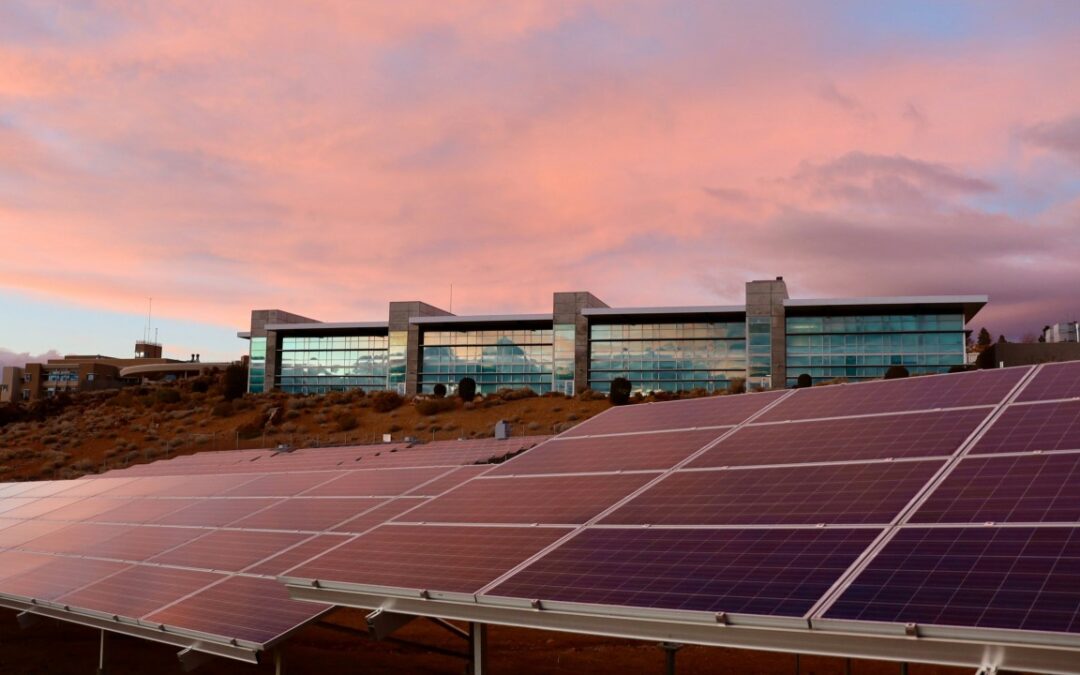
Aberystwyth University’s solar park demonstrates how universities can generate surplus power, enhance sustainability credentials, and provide a live research and teaching resource. Similar initiatives exist elsewhere: Keele University has installed wind turbines and solar arrays as part of its Smart Energy Network Demonstrator, while the University of Edinburgh and Lancaster University operate substantial solar projects on their estates.
Another promising model involves partnerships with local industry and public sector bodies. For example, universities can co-invest in regional wind or solar farms, securing a stable energy supply while contributing to community decarbonisation goals. Such ventures share costs, risks, and benefits across multiple stakeholders, strengthening the civic role of higher education in local energy transitions.
Value Creation
Adopting renewable energy through cooperative ventures creates value across multiple dimensions:
- Financial: Lower energy costs, stable budgets, income from surplus generation sold back to the grid, and revenue from on-campus EV charging.
- Manufactured: Investment in infrastructure and resilience of the local grid.
- Intellectual: Development of new toolkits, technologies, and research outputs.
- Human: Opportunities for staff and students to engage with sustainability in practice.
- Educational: Attracting students to institutions powered by clean energy, and creating engineering and sustainability hubs for learning.
- Social & Relationship: Stronger partnerships with communities, industry, and government.
- Natural: Reduced carbon emissions and improved environmental stewardship.
This holistic model of value demonstrates that renewable energy adoption is not just about savings but about positioning universities as leaders in sustainable innovation.
Regional Variations
Regional contexts will shape cooperative models:
- All-Wales: Expansion from individual initiatives to a sector-wide network, potentially linking primary, secondary, and tertiary education providers.
- Other Nations: Scotland’s 18 higher education institutions and Northern Ireland’s smaller system lend themselves to compact, collaborative models. England’s 100+ universities may be best served through regional clusters such as GW4, N8, or the Russell Group.
- Local Industry Partnerships: In regions with strong renewable projects, universities could partner with councils, NHS trusts, or local businesses to co-own and benefit from shared energy infrastructure.
Regional diversity creates challenges but also enables locally tailored approaches that match governance structures and energy opportunities.
Mission-Oriented Actions
A mission-oriented approach, inspired by Mariana Mazzucato’s work, reframes renewable adoption as a collective challenge akin to historic innovation drives. Universities could commit to a mission of achieving 100% renewable energy adoption across the sector, mobilising partners and resources around a shared goal.
To realise this mission, coordinated action is required:
- Funding: Mobilise blended finance from government, research councils, and industry.
- Forecasting: Develop robust demand models accounting for surplus sales to the grid and EV charging infrastructure.
- Policy and Regulation: Advocate for frameworks that recognise universities as strategic energy actors.
- Political Engagement: Build alliances that transcend electoral cycles and ensure long-term support.
This combination of mission-led ambition and pragmatic action provides universities with a roadmap to scale from pilots to transformative energy cooperatives.
Conclusion
Aberystwyth’s solar park, alongside initiatives at Keele, Edinburgh, and Lancaster, shows that universities can take practical steps toward energy self-sufficiency while advancing their civic role. By investing in cooperative models, forecasting demand — including surplus generation and local EV charging — creating value across multiple domains, and adapting to regional contexts, higher education can form a national green energy community.
Framed as a mission-driven endeavour, renewable adoption enhances institutional reputation, attracts students, and fosters learning hubs that connect education with sustainability in practice. Universities thus stand at the forefront of the transition to a greener, more collaborative future.
Invitation to Collaborate
The transition to green energy offers UK universities a unique opportunity to rethink their role — not just as energy consumers, but as drivers of sustainable change. By adopting cooperative models, investing in renewable infrastructure, and leveraging institutional partnerships, universities can lead the sector in innovation, environmental stewardship, and practical action.
Is your university ready to move beyond being just an energy consumer and become a driver of sustainable change? At Better Generation Solutions, we help institutions unlock their future potential.
By rethinking institutional strategy and building collaborative resilience, we can help your university cut costs, attract students, and lead the sector in environmental innovation.
Join us in shaping a future where universities power not just their campuses, but wider communities.
References
- HESA — Estates Data Table 2: https://www.hesa.ac.uk/data-and-analysis/estates/table-2
- Aberystwyth University Solar Farm: https://localpartnerships.gov.uk/projects/solar-farm/
- Keele University Renewable Energy Park: https://www.keele.ac.uk/estates/projects/recentlycompletedprojects/environmentalprojects/renewableenergypark/
- University of Edinburgh Solar Farm: https://sustainability.ed.ac.uk/news/2020/solar-farm
- Lancaster University Solar Farm: https://www.lancaster.ac.uk/facilities/estates/solar-farm/
- Mazzucato — Mission-Oriented Industrial Strategy: https://www.ucl.ac.uk/bartlett/sites/bartlett/files/mission-oriented_industrial_strategy._global_insights_2024.pdf